

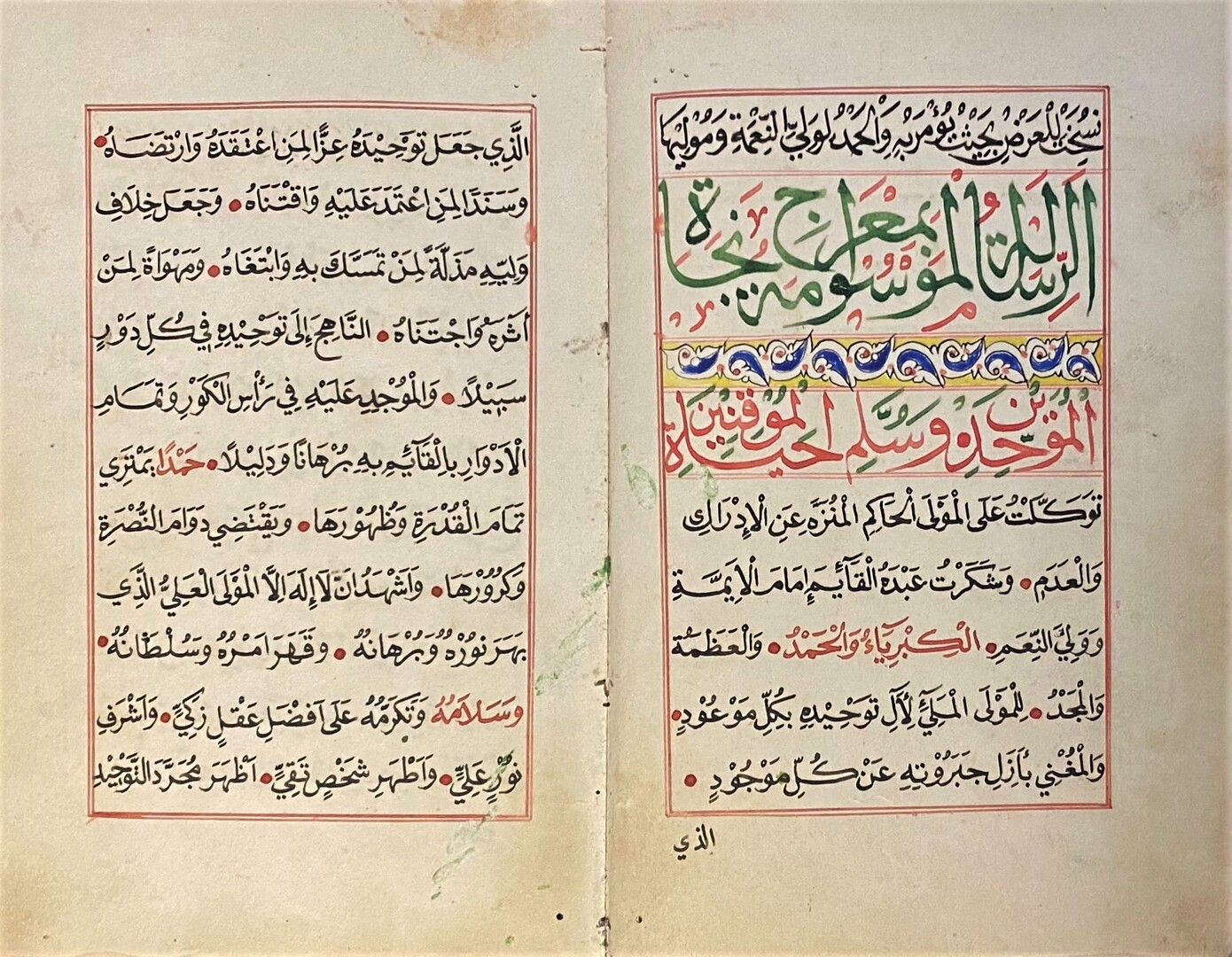
Al-Risalah al-Mawsumah bi-Mi’raj Najat.
Hamza bin Ali bin Ahmad.

Synopsis
An important work on the Druze religion.
Hamza ibn Ali ibn Ahmad, an Ismaili mystic and scholar from Zozan, Khorasan, in the Samanid Empire and studied philosophy and theology before moving to Fatimid Egypt in the tenth century A. D. in 1014 or 1016, where he assembled a group of scholars that met regularly in the Raydan Mosque, near the Al-Hakim Mosque. In 1017, Hamza broke with the mainstream of Ismaili and established a Tawheed (Oneness) movement – later known as Deuzism – attributing to Al Hakim superhuman attributes surpassing those of the Imam, as recognised by the Ismailis and other Batini (hetrodox muslim) sects. Hamza gained the support of the Fatimid caliph al-Hakim bi-Amr Allah, who issued a decree promoting religious freedom and eventually became a central figure in the Druze faith.
Hamza went into hiding soon after the disappearance of Al Hakim in 1021, leaving the leadership of the Da’wa to Al Muqtana Baha’ Uddin. One contemporary source claims that he fled to Mecca, where he was recognized and executed. His disciple Baha al-Din al-Muqtana resumed Hamza’s missionary effort in 1027–1042, finalizing the doctrines of the Druze faith.


